Missing teeth can affect your appearance, chewing ability, and confidence. Dental implants provide a long-term solution by replacing both the tooth root and visible tooth. This guide explains dental implant types, procedure steps, costs, benefits, and factors that influence treatment pricing in Chandigarh.
What are Dental Implants ?
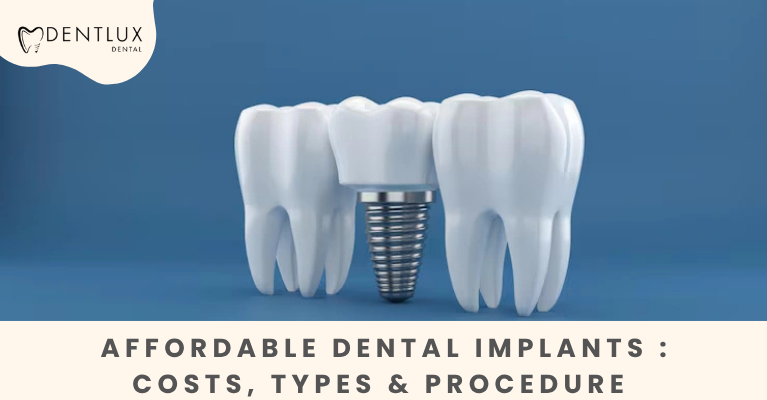
A dental implant is a sophisticated medical-grade replacement for a missing tooth. Unlike traditional surface-level treatments, an implant acts as an artificial root. It is essentially a small, sturdy post—typically manufactured from biocompatible titanium or ceramic—that is surgically inserted into the jawbone.
The magic of a dental implant lies in its ability to fuse with your living bone. Through a biological process called osseointegration, your jawbone grows around the post, locking it into place just as securely as a natural tooth root. This creates a rock-solid foundation for a crown, bridge, or denture. It is the only dental restoration available today that mimics the entire anatomy of a tooth, from the root beneath the gums to the visible crown above them.
Types of Dental Implants
There are 2 types of dental implants , these two are the primary categories recognized by dental community :
- Endosteal Implants
This is the most common variety used in modern dentistry. Shaped like small screws, cylinders, or blades, they are placed directly into the jawbone. These are ideal for patients who have healthy, dense bone tissue. - Subperiosteal Implants
For patients who have suffered significant bone loss and cannot (or do not wish to) undergo a bone grafting procedure, these are a viable alternative. Instead of going into the bone, a metal frame is placed on top of the jawbone but under the gum tissue. As the gums heal, the frame becomes fixed to the jaw.
Preferred Age for Dental Implant
A common misconception is that dental implants are only for the elderly. In reality, they are suitable for almost any adult, though age plays a specific role in the timing of the procedure.
- Lower Limit :
You cannot place an implant in a jaw that is still growing. If an implant is placed in a teenager, it will remain static while the surrounding bone and teeth continue to shift, leading to severe misalignment. Generally, surgeons wait until at least age 18 for men and age 16 for women, though X-rays are often used to confirm that growth is 100% complete. - Upper Limit :
There is no “too old” for dental implants. Success depends on bone density and overall health, not the number of candles on a birthday cake. Whether you are 45 or 85, as long as you have the bone structure to support the post and your body can heal effectively, you are a candidate.
Procedure to do the Treatment :
- Initial Consultation & Assessment: A comprehensive dental exam, X-rays, or 3D scans are taken to assess bone density, gum health, and suitability for the implant.
- Treatment Planning: The surgeon develops a personalized plan, determining the exact placement location and whether extractions or bone grafting are needed beforehand.
- Tooth Extraction (If Necessary): If a damaged or infected tooth is still in place, it is removed. Sometimes a temporary implant can be placed immediately (immediate loading).
- Bone Grafting (If Necessary): If the jawbone is too thin or soft, a bone graft is done to create a solid foundation. This may require extra healing time.
- Implant Placement Surgery
- Anesthesia: Local anesthesia is administered to numb the area, with options for sedation.
- Incision: The surgeon makes a small incision in the gum to expose the jawbone.
- Drilling & Placement: A precise hole is drilled, and the titanium screw (implant) is inserted into the bone.
- Suturing: The gum tissue is stitched closed over the implant site.
- Osseointegration (Healing Phase): Over 3 to 6 months, the jawbone fuses with the implant, anchoring it securely in place. A temporary tooth replacement can be worn during this time.
- Abutment Placement: Once healed, a second minor surgery opens the gum to attach an abutment—a connector piece—to the implant. A healing cap may be placed to shape the gums, which stays in place for a few weeks.
- Final Restoration: After the gums heal, the final artificial tooth (crown) is created, tailored to match the appearance of natural teeth, and is screwed or cemented onto the abutment.
- Follow-Up Care: Regular dental checkups are necessary to ensure the implant is stable and surrounding gums are healthy.
Cost to install Dental Implant
- Single Tooth Implant: ₹20,000 – ₹50,000 (implant screw only) or ₹35,000 – ₹75,000 (with crown).
- All-on-4/6 Full-Arch: ₹2,00,000 – ₹5,00,000 per jaw.
- Bone Grafting: ₹5,000 – ₹25,000 (if required).
- Sinus Lift: ₹10,000 – ₹40,000 (if required).
The price mentioned may vary from clinic to clinic and which place the clinic is located.
On what basis these costs are estimated ?
- Implant Brand/System: Premium brands (e.g., Nobel Biocare, Straumann) cost more than economical options.
- Material: Zirconia crowns are generally more expensive than porcelain-fused-to-metal (PFM).
- Surgeon’s Expertise: Experienced implantologists or specialized centers may charge higher fees.
- City: Metro cities like Bangalore and Mumbai may be higher on the cost spectrum compared to smaller cities.
Common Implant types with cost
| Implant Type | Placement Location | Suitable For | Typical Cost Range |
|---|---|---|---|
| Endosteal Implant | Inside the jawbone | Most patients with adequate bone | ₹30,000–₹50,000 |
| Subperiosteal Implant | Above the jawbone, under the gum tissue | Patients with reduced bone volume | ₹30,000–₹65,000 |
| Zygomatic Implant | Anchored in the cheekbone (zygoma) | Patients with severe upper jaw bone loss | ₹3,00,000 to ₹7,00,000+ per arch |
Dental Implants vs Bridges vs Dentures
| Feature | Dental Implants | Dental Bridge | Denture |
|---|---|---|---|
| Replaces Tooth Root | Yes | No | No |
| Preserves Jawbone | Yes | No | No |
| Fixed in Place | Yes | Yes | No |
| Natural Appearance | Excellent | Good | Moderate |
| Lifespan | 15+ Years | 5–15 Years | 5–10 Years |
| Affects Adjacent Teeth | No | Yes | No |
Advantages of Dental Implants
Preserves Jawbone Health
When a tooth is missing, the jawbone in that area can gradually shrink over time. Dental implants act like natural tooth roots and help keep the jawbone strong and healthy.
Lets You Eat Comfortably
Dental implants stay firmly in place, allowing you to enjoy foods such as apples, nuts, and other crunchy foods without worrying about movement or discomfort.
Supports Clear Speech
Because implants are fixed in the mouth, they help you speak naturally. Unlike loose dentures, they do not slip or affect pronunciation.
Protects Nearby Teeth
Dental implants stand on their own and do not rely on surrounding teeth for support. This means healthy neighbouring teeth do not need to be altered or reduced, as they often do with dental bridges.
Looks and Feels Natural
Implants are designed to blend with your natural teeth, helping restore both your smile and confidence while providing a comfortable, natural feel.
Takeaway
In summary, dental implants represent the gold standard in restorative dentistry, offering a permanent solution that mimics natural tooth anatomy to provide unparalleled stability and bone health. While the journey involves a financial investment and a multi-month healing process, the result is a functional, beautiful smile that can last a lifetime. To take the first step toward restoring your confidence, book an appointment with a qualified dental specialist today for a personalized evaluation and 3D scan.